COALESCE
Future Proofing Senegal's Great Green Wall

About
Across the Sahel, climate change has exacerbated desertification and heightened food, water, and energy insecurity, placing major barriers to development in a region already experiencing widespread poverty. The Great Green Wall (GGW) is one of the world’s largest and most ambitious land restoration initiatives that spans 8,000 km across the Sahel. The GGW is a broad initiative that encompasses a diverse set of sustainable land management approaches (including tree planting) that seek to restore landscapes and improve livelihoods across the region. However, a recent landmark report revealed that only 4% of the targeted restoration area has been achieved. The report identified many challenges to achieving the GGW ambitions, including insufficient technical knowledge on reforestation and a lack of efficient monitoring programs.
In Senegal, >18 million trees have been planted. Yet, this represents less than 10% of the targeted restoration area, and replanting programmes have been beset with high tree mortality rates and a lack of rigorous monitoring data. Working alongside Senegal’s National Forestry Research Center and the Senegalese Institute for Agricultural Research (ISRA), our project aims to address these challenges and provide a basis for future proofing the GGW in Senegal and across the Sahel. The project will - 1) use state-of-the-art plant environmental growth chamber experiments to identify tree species that are most resilient to Senegal’s future climate conditions, 2) use participatory approaches to engage with local communities and build capacity for monitoring GGW reforestation and ecosystem service delivery in Senegal, and 3) improve governance and policy frameworks that support GGW interventions.
This project is realized through Strand 2B of Research Ireland's COALESCE (Collaborative Alliances for Societal Challenges) funding programme, with funding from Irish Aid.
Project team
Dr Diatta Marone, ISRA (Co-Principal Investigator)
Dr John Devaney, Maynooth University (Co-Principal Investigator)
Dr Mame Sarr, Research Scientist, ISRA
Dr Duyen Hoang, Postdoctoral Researcher, Maynooth University
Mohameth Lamine Ka, Research Assistant, ISRA
Mamour Diop, MSc student, ISRA
Dame Ndiaye, MSc student, ISRA
Project Work Packages
Research Tasks
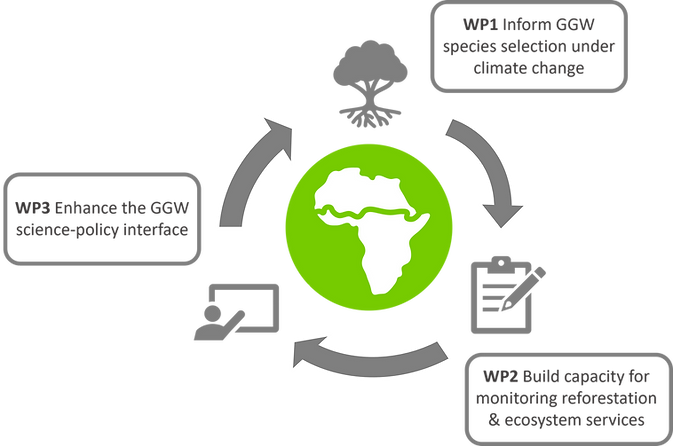
Work Package 1: Inform GGW species selection under climate change
Climate change will continue to alter environmental conditions in the Sahel in the coming decades, yet we know little about how different GGW tree species will respond to climates of the future. In this work package, we are utilizing state-of-the-art plant growth chambers at the Variable Atmosphere and Light Lab in Trinity College Dublin to assess the growth of key Senegalese GGW tree species under current and future climate conditions.

CONVIRON PGC20 plant growth chambers at the Variable Atmosphere and Light lab at Trinity College Dublin.
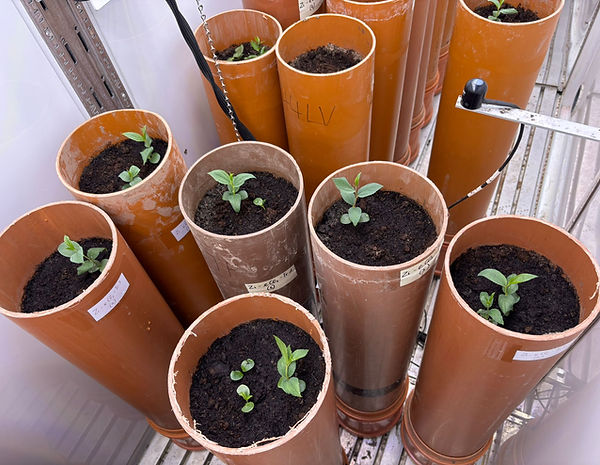
Our study species growing under simulated future climate conditions in plant growth chambers
Work Package 2. Monitoring reforestation and ecosystem services
Despite significant progress towards reaching GGW planting targets in Senegal, high mortality of planted seedlings threatens the long-term persistence of reforested areas. High mortality rates have been attributed to a number of factors, including planting inappropriate species. In this work package, experienced forest ecologists and agroecologists aim to develop a GGW tree survival and growth monitoring protocol. We are using novel low-cost plant ecophysiology tools to track tree health and provide an early warning system that can accelerate remediation.

Measuring photosynthetic heath of planted seedlings at Great Green Walls sites in Northern Senegal

Collecting soil samples for measuring soil carbon
Communities across current and proposed GGW areas in Senegal utilize the land for multiple purposes, including for grazing animals and gum arabic production. Consequently, understanding the extent to which restoration activities alter ecosystem service delivery for local communities is a key step in designing sustainable GGW landscapes. This work package will also help develop procedures for monitoring the ecosystem services associated with GGW areas. Adopting a community participatory approach, the project is using the Toolkit for Ecosystem Service Site-based Assessment (TESSA) to assess how GGW actions are impacting access to water, provision of cultivated and wild goods, carbon stocks, and biodiversity.
Work Package 3. Enhancing the GGW Science-Policy interface
Science–policy interfaces are critical in shaping environmental governance. A recent GGW report highlighted insufficient flows of information and a lack of mainstreaming of environmental change and action into regional and national policy as major barriers to GGW progress. In this work package, we seek to build a better GGW science–policy interface so that basic science and participatory practice is translated to policy.